Application Security in Cloud
- Avinashh Guru
- May 28, 2025
- 2 min read

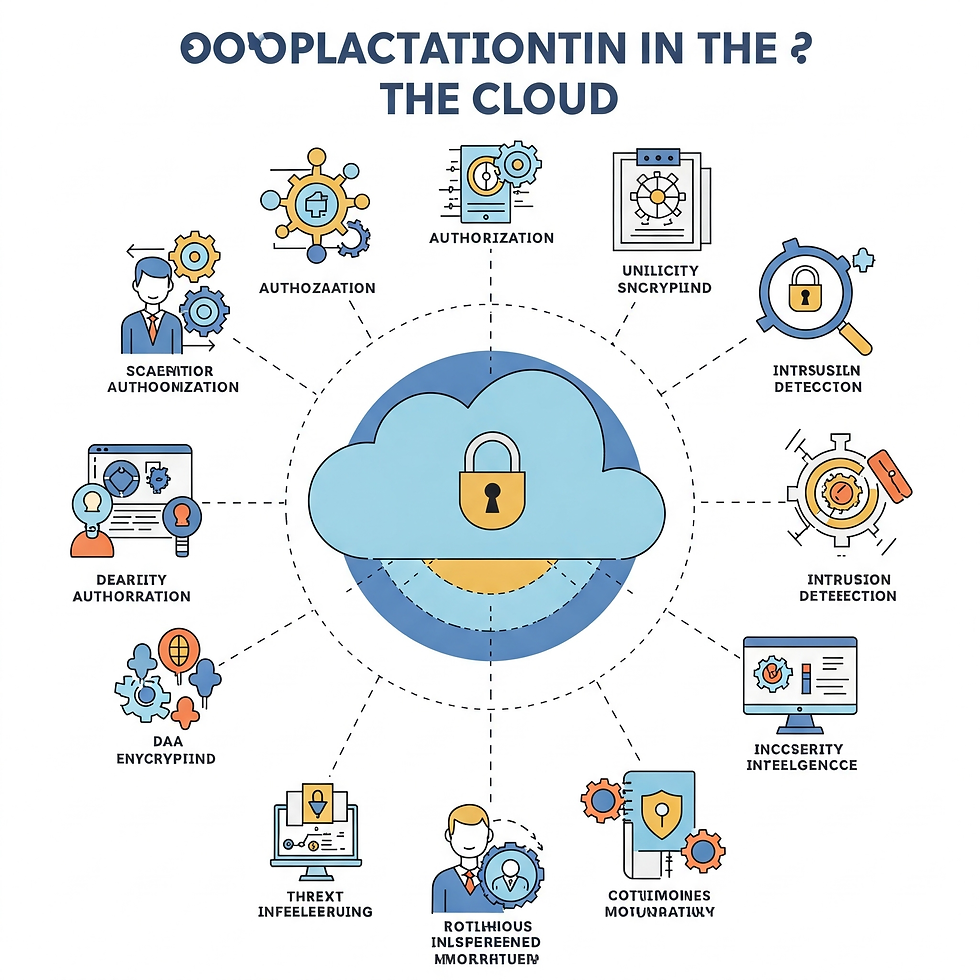
Cloud application security is essential for protecting data, applications, and infrastructure in cloud environments. As businesses increasingly rely on cloud-based solutions, understanding risks like data breaches, misconfigurations, and insecure APIs becomes critical. Below is a structured, detailed guide for your blog post, combining best practices, threats, and actionable strategies.
What is Cloud Application Security?
Cloud application security involves policies, tools, and practices to safeguard cloud-based applications from unauthorized access, data breaches, and cyberattacks. It spans identity management, encryption, threat monitoring, and compliance to ensure data confidentiality, integrity, and availability.
Key Components:
Identity and Access Management (IAM): Enforce role-based access controls (RBAC) and multi-factor authentication (MFA) to limit user privileges.
Encryption: Protect data in transit, at rest, and in use using SSL/TLS and advanced encryption standards.
Continuous Monitoring: Detect anomalies in real time with automated alerts for suspicious activity.
Security Audits: Regularly assess configurations and compliance with standards like GDPR or HIPAA.
Top Cloud Security Threats
Threat | Impact | Mitigation Strategies |
Misconfigurations | Exposes sensitive data (e.g., open S3 buckets) | Automated configuration checks and audits. |
Insecure APIs | Unauthorized access to backend systems | API gateways, rate limiting, and authentication. |
Insider Threats | Data leaks from employees or contractors | Least-privilege access and activity logging. |
Data Breaches | Financial loss and reputational damage | Encryption, MFA, and network segmentation. |
Best Practices for Securing Cloud Applications
1. Implement Strong Access Controls
Use MFA for all user accounts and enforce RBAC to limit access to sensitive data.
Adopt Single Sign-On (SSO) to centralize authentication and reduce password fatigue.
2. Encrypt Data at Every Stage
In transit: Use TLS/SSL for data moving between services.
At rest: Encrypt databases and storage buckets with AES-256.
In use: Leverage confidential computing for processing encrypted data.
3. Automate Security Monitoring
Deploy tools like Web Application Firewalls (WAFs) and Cloud Access Security Brokers (CASBs) to block malicious traffic.
Enable logging for APIs, user activity, and network traffic to detect anomalies.
4. Address Misconfigurations
Use infrastructure-as-code (IaC) tools like Terraform to enforce secure configurations.
Regularly audit cloud storage permissions and network settings.
5. Secure APIs
Validate inputs, enforce rate limits, and use OAuth 2.0 for authorization.
Monitor API traffic for unusual patterns (e.g., spikes from unrecognized IPs)
Shared Responsibility in Cloud Models
Service Model | Provider Responsibility | Your Responsibility |
IaaS | Physical infrastructure, hypervisors | OS, applications, and data security. |
PaaS | Runtime, middleware, and OS | Application code and user access. |
SaaS | Application, infrastructure, and updates | Data governance and user permissions. |
Tools and Solutions
IAM Solutions: Okta, Azure Active Directory.
Encryption: AWS KMS, HashiCorp Vault.
Threat Detection: Darktrace, Splunk.
Conclusion
Cloud application security demands a proactive approach combining access controls, encryption, and continuous monitoring. By understanding threats like misconfigurations and insecure APIs, organizations can adopt strategies to mitigate risks while leveraging cloud scalability. Prioritize regular audits, automate security workflows, and collaborate with cloud providers to stay ahead of evolving threats


Comments