Continuous Testing Strategies: A Comprehensive Guide
- Avinashh Guru
- Jun 4, 2025
- 2 min read

Continuous Testing (CT) is a cornerstone of modern DevOps and agile software development, enabling teams to deliver high-quality software at speed. Here’s an in-depth look at effective continuous testing strategies, best practices, and actionable tips for your next blog post.
What is Continuous Testing?
Continuous Testing is the practice of executing automated tests throughout the software development lifecycle (SDLC), rather than confining testing to a single phase. The primary goals are to detect defects early, provide rapid feedback, and ensure that every code change is validated before moving forward.
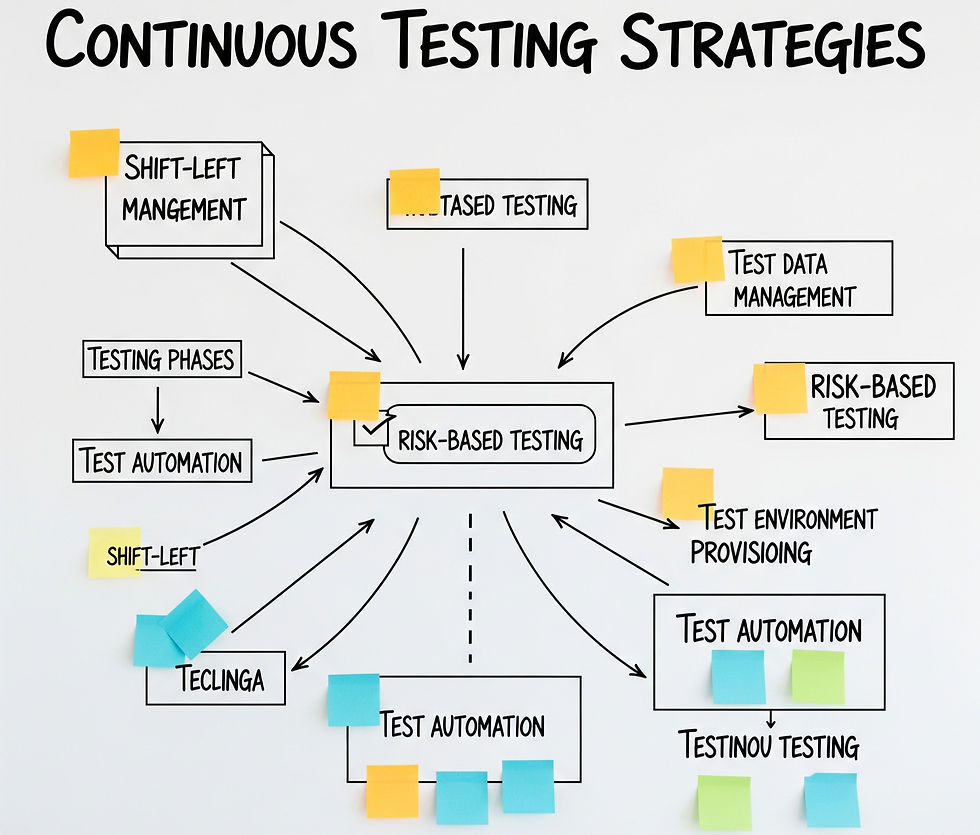
Key Elements of a Continuous Testing Strategy
1. Shift-Left Testing
Move testing activities earlier in the development cycle.
Developers and testers collaborate to write and run tests as code is developed, catching defects sooner and reducing late-stage surprises.
2. Comprehensive Test Coverage
Combine unit, integration, functional, and performance tests.
Ensure all aspects of the application are validated, from individual components to system-wide interactions.
3. Robust Test Automation
Automate repetitive and critical tests to accelerate feedback.
Use frameworks and tools that integrate seamlessly with your CI/CD pipeline for maximum efficiency.
4. Realistic Test Environments
Use cloud-based, containerized, or virtualized environments that closely mimic production.
Test across multiple platforms, browsers, and devices to ensure compatibility and performance.
5. Integration with CI/CD Pipelines
Embed automated tests into every stage of the CI/CD process.
Trigger tests on every code commit, build, and deployment, ensuring continuous validation.
6. Continuous Feedback Loops
Provide real-time test results and actionable insights to developers.
Enable rapid identification and resolution of issues, supporting a culture of continuous improvement.
7. Effective Test Data Management
Use up-to-date and realistic test data to mirror real-world scenarios.
Ensure data privacy and compliance while maintaining test reliability.
8. Parallel and Scalable Testing
Run multiple tests concurrently to reduce execution time.
Use cloud-based infrastructure to scale testing efforts up or down as needed.
Best Practices for Implementing Continuous Testing
Automate Extensively: Prioritize automation for regression, smoke, and critical path tests to catch issues early and save time.
Start Small, Scale Gradually: Begin with a minimal set of stable test cases, then expand coverage as confidence grows and the process matures.
Maintain Test Scripts: Regularly review and update test cases to keep them relevant as the application evolves.
Foster Collaboration: Encourage developers, testers, and operations teams to work closely, sharing responsibility for quality.
Monitor and Analyze Results: Continuously track key metrics (e.g., test pass rates, defect trends, release frequency) to identify bottlenecks and refine strategies.
Adopt a Multi-Layered Approach: Structure your testing to cover different levels (unit, integration, system, acceptance), ensuring no gaps in validation.
Leverage Cloud and Virtualization: Use cloud-based testing tools and virtual environments to replicate production and increase test coverage.
Continuous Testing vs. Traditional Testing
Aspect | Continuous Testing | Traditional Testing |
Timing | Throughout SDLC | After development phase |
Feedback | Immediate, continuous | Delayed, batch-based |
Automation | Extensive | Limited or manual |
Integration | Embedded in CI/CD | Separate from development |
Risk Detection | Early and frequent | Late, often post-release |
Final Thoughts
Continuous Testing is not just a set of tools or scripts—it’s a cultural shift that prioritizes quality, speed, and collaboration. By implementing these strategies, organizations can achieve faster delivery cycles, higher software reliability, and a robust DevOps pipeline.
Adopt continuous testing to stay ahead in today’s fast-paced software landscape and deliver exceptional value to your users.


Comments