Hybrid Cloud vs Multi-Cloud: Choosing the Right Strategy for AI Scalability and Security
- maheshchinnasamy10
- May 8, 2025
- 3 min read
Introduction:
As enterprises accelerate AI adoption, their cloud strategy determines whether they can efficiently train models, scale workloads, and ensure compliance. Given the computational intensity and data sensitivity of AI, businesses must choose between hybrid cloud and multi-cloud architectures. While both hybrid cloud and multi-cloud approaches offer distinct advantages, understanding their nuances is crucial for organizations aiming to build robust AI infrastructure.
This article explores the key differences between these strategies and provides practical guidance for enterprises preparing for AI adoption.
Understanding Modern AI Infrastructure Requirements:
AI infrastructure has evolved significantly, demanding advanced computing power, data management, and networking capabilities. Organizations must consider these key elements to ensure AI readiness:
High-Performance Computing (HPC):
AI workloads, especially deep learning models, require substantial computational power. Enterprises need access to specialized hardware accelerators like GPUs, TPUs, and FPGAs to train AI models efficiently. Hybrid and multi-cloud solutions allow businesses to scale their computing resources dynamically based on AI workload demands.
Data Storage and Management:
AI models require massive amounts of structured and unstructured data. Enterprises need to implement scalable storage solutions, such as object storage and distributed databases, to manage large datasets efficiently. Data localization and compliance requirements further influence whether businesses choose on-prem, hybrid, or multi-cloud storage.
Low-Latency Networking:
Real-time AI applications, such as autonomous systems and financial trading models, rely on ultra-low-latency networking to process data instantly. In AI model training, fast data transfers between cloud environments reduce bottlenecks and enhance iterative learning. Technologies like edge computing software-defined networking (SDN), and digital interconnection enhance data transmission speeds and security. Digital interconnection reduces latency by enabling direct, high-speed connections between enterprises, cloud providers, and AI workloads, bypassing the public internet.
Services like private cloud exchanges and direct interconnection platforms optimize AI data processing across environments, making digital interconnection essential for hybrid and multi-cloud strategies.
Security and Compliance:
AI infrastructure must adhere to stringent security protocols, ensuring data privacy, encryption, and regulatory compliance. Industries like finance and healthcare must balance AI innovation with adherence to GDPR, HIPAA, and other legal frameworks influencing their choice of cloud strategy.
Scalability and Cost Efficiency:
AI projects evolve rapidly, requiring flexible infrastructure that scales on demand. Enterprises must evaluate pay-as-you-go cloud models versus on-prem investments to optimize costs. Multi-cloud strategies enable cost optimization by selecting the most competitive AI services across cloud providers.
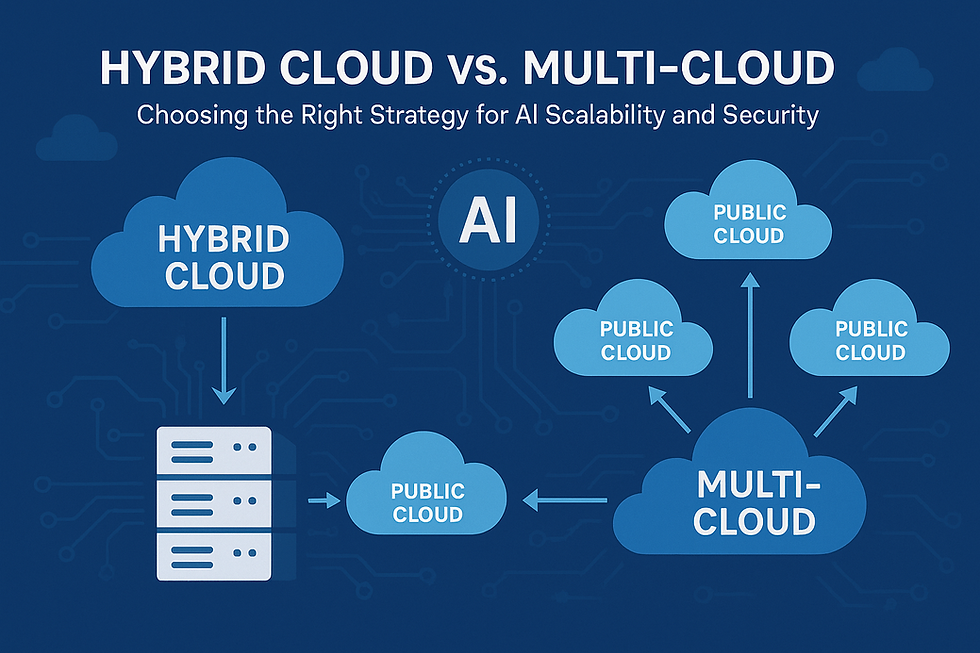
Hybrid Cloud vs. Multi-Cloud at a Glance:
Security and compliance: Hybrid cloud offers better control over sensitive AI data, while multi-cloud requires additional security policies across providers.
Performance: Hybrid cloud minimizes latency for mission-critical workloads, while multi-cloud depends on provider-specific optimizations.
Scalability: Multi-cloud scales more flexibly across cloud vendors, whereas the hybrid cloud is constrained by on-prem resources.
AI tools: Multi-cloud enables access to a diverse set of AI tools, while hybrid cloud may require custom AI infrastructure.
Choosing the Right Cloud Strategy for AI Workloads:
Hybrid Cloud for AI
A hybrid cloud approach is often preferred by enterprises that handle large-scale AI workloads with stringent security and compliance requirements.
Advantages
Data sovereignty and compliance: Keeps sensitive AI data on-premises while leveraging the cloud for AI model training.
Latency optimization: Reduces data transfer times by keeping critical workloads closer to users.
Cost control: Balances on-prem and cloud resources to optimize costs.
Custom AI infrastructure: Allows enterprises to integrate custom AI hardware like GPUs, TPUs, and FPGAs on-premises.
Multi-Cloud for AI
A multi-cloud approach benefits enterprises that prioritize flexibility, scalability, and access to diverse AI tools from multiple cloud providers.
Advantages:
Avoids vendor lock-in: Enterprises can select AI services from different cloud vendors.
High availability and redundancy: AI workloads can fail over between clouds.
Cost optimization: Enables pricing comparisons and workload distribution to reduce costs.
Best-of-breed AI tools: Provides access to unique AI services (e.g., Google Cloud’s TensorFlow AI tools, AWS SageMaker, and Azure ML).
Real-World Industry Trends and Future AI-Cloud Strategies:
As AI workloads evolve, enterprises are increasingly moving towards a hybrid multi-cloud model, combining the security of hybrid cloud with the flexibility of multi-cloud AI services.
Key Emerging Trends:
Confidential computing: AI model training on multi-cloud while keeping sensitive data encrypted (e.g., Google’s confidential VMs).
Hybrid multi-cloud convergence: Enterprises using hybrid cloud for regulated data and multi-cloud for AI processing (e.g., financial services firms balancing security and scalability).
Edge AI and 5G integration: AI inference happening closer to end-users with hybrid cloud edge nodes (e.g., autonomous vehicle manufacturers deploying AI at the edge).
Conclusion:
The choice between hybrid cloud and multi-cloud strategies for AI readiness depends on various factors specific to each organization. A hybrid approach may be more suitable for organizations with significant existing infrastructure and strict data governance requirements. In contrast, a multi-cloud strategy might better serve organizations looking to leverage best-of-breed AI services and maintain maximum flexibility.
Some enterprises opt for a hybrid multi-cloud model, combining the security of hybrid cloud with the flexibility of multi-cloud AI services. This approach allows organizations to maintain strict governance while leveraging best-of-breed AI tools across providers.


Comments