Kubernetes for Edge Computing: Powering the Next Generation of Distributed Applications
- Avinashh Guru
- Jun 12, 2025
- 3 min read

As the demand for real-time data processing and low-latency applications grows, edge computing has emerged as a crucial architectural shift. Kubernetes, the leading container orchestration platform, is now at the forefront of this transformation—enabling organizations to deploy, manage, and scale containerized workloads not just in the cloud, but at the very edge of the network.
What is Kubernetes for Edge Computing?
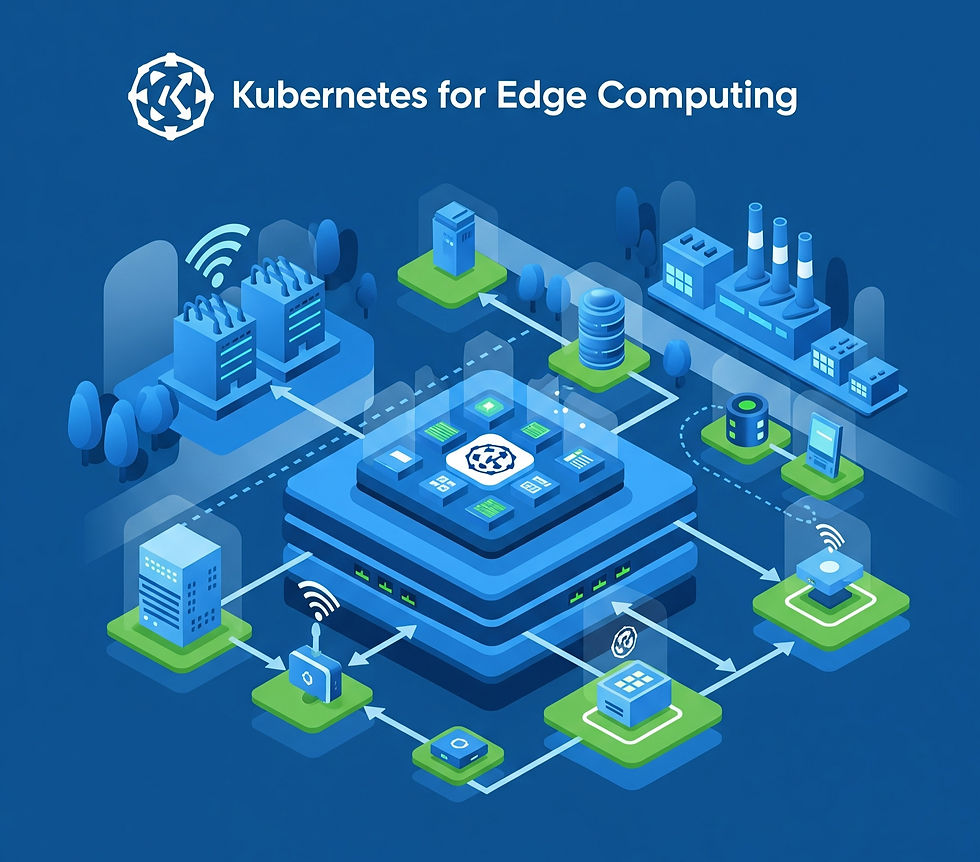
Kubernetes for edge computing refers to deploying and managing Kubernetes clusters at edge locations—closer to where data is generated, such as IoT devices, sensors, and remote sites—instead of relying solely on centralized data centers. This approach reduces latency, enhances security, and supports real-time processing, making it ideal for applications like IoT, autonomous vehicles, and smart cities.
Key Benefits
Reduced Latency: Processing data near its source minimizes round-trip time, enabling immediate responses for time-sensitive applications.
Enhanced Security: Localized data processing reduces the risk of data interception during transmission.
Real-time Analytics: Essential for scenarios like industrial automation, traffic management, and predictive maintenance.
Cost Efficiency: Limits the amount of data sent to centralized clouds, reducing bandwidth and storage costs.
Core Use Cases
IoT Deployments: Smart devices and sensors process data locally, responding faster and using less bandwidth.
Smart Cities: Real-time traffic control, environmental monitoring, and public safety systems benefit from edge analytics.
Autonomous Systems: Vehicles and robots require instant data processing for navigation and safety.
Retail & Supply Chain: Edge computing optimizes operations by enabling local decision-making and analytics.
Architectural Approaches
There are several ways to architect Kubernetes for edge computing:
Approach | Description | Example Tools |
Full Cluster at Edge | Deploy a lightweight Kubernetes cluster directly on edge nodes. | K3s, MicroK8s |
Cloud-Controlled Edge Nodes | Control plane remains in the cloud; edge nodes run workloads and sync with the cloud. | KubeEdge |
Hybrid/Hierarchical | Combines cloud and edge clusters, sometimes with virtual kubelets for flexibility. | Virtual Kubelet |
Lightweight Distributions:
K3s: Stripped-down Kubernetes, optimized for resource-constrained edge environments.
MicroK8s: Easy-to-deploy Kubernetes for small-scale or IoT edge scenarios.
KubeEdge: Extends Kubernetes natively to the edge, handling unreliable networks and device state synchronization.
Key Features and Strategies
Containerization: Isolates applications, making them portable and lightweight—ideal for edge devices with limited resources.
Distributed Workload Management: Kubernetes distributes workloads geographically, placing them close to data sources using node affinity and taints/tolerations.
Autoscaling & Fault Tolerance: Features like Horizontal Pod Autoscaler (HPA) and failover mechanisms ensure resilience and adaptability at the edge.
Centralized Control, Decentralized Execution: The Kubernetes cluster acts as a unified control plane, simplifying deployment and management across a fleet of edge devices.
Challenges
Network Reliability: Edge environments often face intermittent connectivity; solutions like KubeEdge are designed to handle these scenarios.
Hardware Constraints: Edge nodes may have limited CPU, memory, and storage, requiring lightweight Kubernetes distributions.
Security: Decentralized nodes increase the attack surface, necessitating robust security practices.
Getting Started
To implement Kubernetes for edge computing:
Choose a lightweight Kubernetes distribution (K3s, MicroK8s, or KubeEdge) suited to your hardware and use case.
Design your architecture for resilience and scalability, leveraging Kubernetes features like node affinity, autoscaling, and DaemonSets.
Prioritize security and efficient resource management in your deployment strategies.
Conclusion
Kubernetes is rapidly becoming the backbone of edge computing, offering the automation, scalability, and flexibility required for modern distributed applications. By extending Kubernetes to the edge, organizations can unlock new levels of performance, efficiency, and innovation—paving the way for smarter cities, responsive IoT systems, and autonomous technologies


Comments